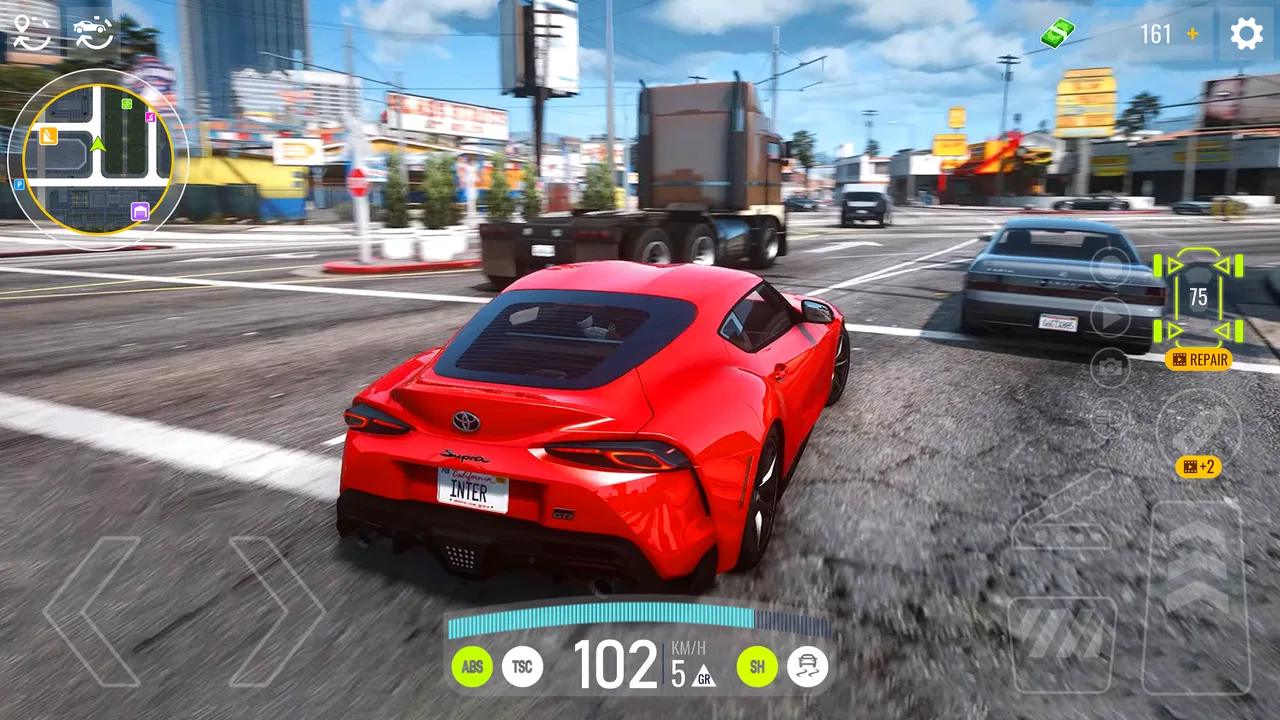
Real Car Driving: Racing Sim
- 4.5
- Rating
- 10.00M
- Installs
- Free
- Price

 Analysis by App-foxy
I spent time with Real Car Driving: Racing Sim as a mobile racing game, paying particular attention to how quickly it gets into the action, how it feels during demanding races, and whether it makes sense for everyday play. My overall impression is that it aims for a more serious driving feel than a simple arcade racer, while still keeping the basic idea easy to understand: choose a car, tune it, and try to beat rivals without losing control.
That balance is the main reason I can see this game appealing to people who want more involvement than tapping through short, automatic races. It is free to start, available for devices running Android 8.1 or later, and carries an Everyone 10+ content rating. The game comes from Racing Games - Make it for fun, and its current version is 1.9.3. Those details matter because this is not positioned as a tiny novelty game that you open once and forget; it is presented as a full racing experience with room for repeated driving and adjustment.
How the speed feels before the race gets serious
The first thing I noticed is that the sense of speed depends less on simply making the car move quickly and more on how well I manage the road, steering, and rival traffic. A racing game can claim to be fast, but if every corner is harmless, speed becomes a visual effect. Here, the more convincing moments come when I have to commit to a line, correct a turn, and decide whether chasing a rival is worth risking a mistake.
You May Also Like

 Pandora - Music & Podcasts
Pandora’s Music Is Easy to Start, but Harder to Recover
Pandora’s strength is its low-effort path from a seed to a station. Its weak spot is how much confidence it asks you to place in connection, setup, and quiet recovery.

 8 Ball Pool
 Is Built on Rivalries, Rematches, and Routine
A close look at the rivalries, rematches, shared routines, and unanswered safety questions that turn a quick pool match into a persistent mobile community.

 Samsung Music
’s Quiet Strength Is Playing What You Already Own
Its reach comes less from spectacle than from dependable access to a personal library. That simplicity is both the app’s strongest retention engine and its ceiling.

 AccuWeather: Weather Radar
AccuWeather Review: A Quick, Clear Forecast for Everyday Decisions
For everyday plans, the best forecast is the one you can understand quickly. AccuWeather makes rain timing, radar, and local conditions easy to act on, with a few trade-offs.

 Hill Climb Racing
Why Hill Climb Racing Still Turns Crashes Into One More Run
A tiny car, a bumpy hill and one more upgrade: Hill Climb Racing keeps resurfacing because its simple chaos makes every near-miss feel personal.

 AliExpress - Shopping App
AliExpress Makes Global Shopping Feel Personal, but Shoppers Bear the Risk
AliExpress turns a global marketplace into a pocket-sized discovery engine. Its reach is useful, its shopping loop compelling, and its trade-offs easy to miss.
More From Our News Desk
View All News


That makes the opening sessions fairly approachable. I did not need to understand every tuning choice before enjoying the driving. A player can begin with the basic racing loop, learn how the car responds, and then pay closer attention to setup choices once the early excitement settles. I like that progression because it prevents the tuning side from becoming a barrier for someone who simply wants to drive.
At the same time, this is not the best choice for someone who wants an instantly spectacular arcade rush with constant boosts, exaggerated jumps, or a race that forgives every collision. The appeal is closer to controlling a car than watching a sequence of effects. When the handling asks for patience, the game feels more rewarding; when I wanted a quick, consequence-free burst of action, a lighter arcade alternative would probably suit me better.
The realistic-physics angle also changes how I approach speed. I found myself thinking about entry speed rather than only acceleration. Braking too late can cost more than a slightly slower start, and a small correction at the wrong moment can spoil the next section of a race. That is a useful distinction for newcomers: the fastest-looking move is not always the fastest way to finish.
My practical advice is to spend the first few races learning the car before spending attention on fine tuning. Notice whether the car feels difficult because of the road, your steering input, or a setup choice. Changing everything at once makes it hard to know what helped. Adjusting one thing at a time gives the tuning system more meaning and helps turn a frustrating race into a useful lesson.
Why tuning matters more than simply choosing the quickest car
The deeper part of the experience is the relationship between car setup and driving style. A player who prefers smooth cornering may value a different balance from someone who brakes late and attacks every straight. I would not treat tuning as a one-time upgrade screen. It is more useful as a way to make the car fit the way I actually drive.
There is a trade-off here. A more involved setup system can give a racing game longer legs, but it can also make progress feel slower for players who do not enjoy experimenting. If you only want to select a vehicle and race immediately, the extra decisions may feel like work. If you enjoy comparing small changes and learning why a car behaves differently, this is where the game has more substance than a basic pick-up-and-play racer.
One overlooked use case is short practice before a busy day. I can play a few races without needing a long session, then use what I learned later when I have more time. The game works better in that pattern than as background entertainment, because even brief sessions can focus on one goal: cleaner turns, better braking, or understanding a rival’s pace.
What happens during heavy racing sessions
The most demanding moments are not necessarily the opening seconds. They arrive when several decisions overlap: maintaining speed, reacting to a rival, correcting a slide, and remembering how the current car responds after tuning. That is when a racing game reveals whether its controls remain readable under pressure. In my experience, the driving is most satisfying when I stay deliberate instead of constantly forcing the car beyond its limits.
Longer play also changes how I judge the game’s resource demands. I would not assume that every phone will deliver the same experience simply because the minimum operating system is Android 8.1. The operating-system requirement tells me whether a device can run the software environment, but it does not guarantee identical comfort across older and newer hardware. Screen size, touch response, available storage, and general device condition can all affect how pleasant racing feels.
For that reason, I would approach the first session as a practical test rather than immediately committing to a long championship-style play period. Play several races, check whether steering remains comfortable, and see whether the device stays responsive after repeated use. If the phone begins to feel strained, lowering expectations is wiser than blaming the driving model. A demanding racing game is only enjoyable when the device can keep up with the player’s decisions.
Another heavy-use issue is concentration. Realistic handling can make a session feel more intense than a casual racer, especially when a late mistake forces a recovery. I prefer that tension in moderate doses. After several close races, I am more likely to make errors from impatience than from lack of knowledge. Taking a short break is genuinely useful here, because returning with a calmer approach often improves lap quality more than changing the car again.
The free entry point helps with testing. I can find out whether the game’s driving style fits me without paying first. However, in-app purchases range from $0.99 to $18.99 per item, so I would be careful around optional spending. The sensible approach is to enjoy the free portion first and decide whether additional purchases solve a real problem for my play style. A purchase should not be a substitute for learning the handling.
A realistic everyday session
Imagine opening the game during a short commute break or after work, when there is enough time for a few races but not enough for a lengthy gaming session. I would start with one familiar car, use the first race to settle into the controls, and make a single tuning adjustment only if a specific weakness keeps appearing. That workflow is more productive than jumping between cars and changing several settings after every loss.
If I repeatedly lose on corners, I would first change my approach: brake earlier, turn more smoothly, and avoid chasing a rival into a poor line. Only after that would I consider whether the car needs adjustment. This is one of the game’s better lessons. It encourages me to separate a driving mistake from a vehicle problem, which saves time and prevents unnecessary spending.
For a player with only a few minutes, the game is best when the goal is narrow. “Win everything” is too vague and can make a short session frustrating. “Keep control through the next difficult turn” is more realistic and gives the session a clear purpose. That habit also makes the racing feel less repetitive because improvement is measured by decisions, not just the final position.
Reliability, recovery, and the cost of a mistake
Reliability in a racing game is not only about whether it opens. It is also about whether the experience remains understandable when something goes wrong. A missed corner, a poor setup choice, or a lost race should teach me something rather than leave me unsure what happened. The physics-focused design gives mistakes a useful cause-and-effect quality when I pay attention to them.
Recovery is especially important. In a forgiving arcade racer, a mistake may disappear almost immediately. In a more controlled driving game, recovery can become part of the challenge: regain a stable line, avoid making the correction worse, and decide whether to keep pushing or protect the rest of the race. I enjoy that kind of recovery when the controls feel predictable. It is less enjoyable when I am unsure whether a result came from my input or from an unclear response.
My recommendation is to treat a lost race as information. Ask whether the problem was speed, timing, steering, or a setup mismatch. That simple review process makes the game more reliable from the player’s point of view because I am not repeating the same mistake blindly. It also reduces the temptation to buy something immediately after a frustrating result.
The game’s popularity gives it a useful sense of confidence for people deciding whether to try it. It has a 4.7 average from around 7.8 thousand ratings and more than 10 million installs. I read that as evidence that the core experience has connected with a substantial audience, though it does not mean every device or every racing preference will match it perfectly. A high average can support the decision to test the game, but personal control comfort still matters more.
One unusual point is the difference between reliability and convenience. A game can be dependable while still demanding attention. This title seems aimed at players willing to learn its driving rather than those looking for a passive experience. If I want something that I can play while distracted, I would choose a simpler racer. If I want mistakes to have understandable consequences, this approach is more appealing.
Who should skip it
I would skip this game if my priority is a very gentle racing experience with almost no learning curve. I would also look elsewhere if I strongly prefer a large social ecosystem, licensed presentation, or a highly cinematic console-style package. Those expectations can lead to disappointment because the strongest reason to try this title is the driving interaction itself, not a promise of every feature associated with bigger racing franchises.
It may also be a poor fit for someone using an older phone that already struggles with demanding games. Android 8.1 is the minimum operating-system requirement, but meeting that requirement is not the same as guaranteeing ideal performance. Players sensitive to heat, stutter, or battery drain should test the game in a short session before settling into longer races.
Families should also pay attention to the Everyone 10+ rating and the presence of in-app purchases. The age label makes the game broadly accessible, but younger players may still need guidance around optional spending. I would set clear purchase expectations before handing the phone over, especially because the available item prices cover a fairly wide range.
Device constraints and choosing the right alternative
On a newer, responsive device, the game’s main strengths are easier to appreciate because steering corrections feel more connected to what I see. On a less capable phone, even small delays can make realistic driving feel unfair. That is why I would judge the game with the device I plan to use, not only by reading the operating-system requirement.
Storage and background activity are also worth considering in ordinary use. I would close unnecessary apps before a serious session, keep the phone reasonably cool, and avoid judging the game during a moment when the device is already overloaded. These are simple habits, but they matter more in racing than in turn-based games because timing is continuous.
Compared with a basic arcade racer, this game offers a stronger reason to replay the same driving challenges: I can improve technique and explore how tuning changes the car. Compared with a large, content-heavy racing alternative, it is easier to approach without treating the game like a second job. The trade-off is that players seeking a huge world, extensive licensed content, or a strong social layer may find a bigger competitor more satisfying.
Compared with purely casual mobile racers, the game asks for more concentration. That is a strength when I want a focused driving session, but a weakness when I only have one hand free or want something effortless. I would choose this title for deliberate play, and a simpler alternative for quick distraction.
The developer name, Racing Games - Make it for fun, also sets a modest expectation. I would approach the game as a focused racing project rather than assuming it will replicate the breadth of a major console series. That makes the strengths easier to recognize: the value lies in the driving loop, tuning decisions, and rival pressure.
My performance verdict after living with the driving loop
My final view is positive, with clear conditions. Real Car Driving: Racing Sim is worth trying if you want a free racing game that treats car control and tuning as meaningful parts of the experience. The perceived speed works best when I drive with intention, and the rival racing becomes more enjoyable once I stop treating every corner as a place to force maximum pace.
The game is less convincing as a universal recommendation. Players who want instant arcade spectacle, effortless controls, or a massive feature-filled racing world should compare it with alternatives built around those priorities. Device capability matters too, so I would begin with a short test rather than assuming the minimum Android version tells the whole performance story.
At no cost to download, with a 4.7 average and a large installed audience, it is an easy game to sample. The important decision comes afterward: do I enjoy learning the car enough to keep tuning and refining my lines? If the answer is yes, the game has a satisfying loop that can turn short sessions into genuine practice. If the answer is no, the extra realism will feel like friction rather than depth.
My recommendation is to try it as a focused driving simulator, not as a mindless time filler. Start with one car, change one variable at a time, and judge the game after several races rather than one unlucky result. For the right player and a capable device, that approach reveals the best part of Real Car Driving: Racing Sim: speed feels earned because control, recovery, and tuning all influence the outcome.
FAQs for Real Car Driving: Racing Sim
01What are the system requirements for Real Car Driving: Racing Sim?
Real Car Driving: Racing Sim requires Android version 5.0 or later and iOS version 10.0 or later. It also recommends at least 2GB of RAM and a dual-core processor for optimal performance. Ensure your device has sufficient storage to accommodate the game’s size, which typically exceeds 500MB after installation.
02Is Real Car Driving: Racing Sim free to play?
Yes, Real Car Driving: Racing Sim is free to download and play. However, it contains in-app purchases that enhance gameplay experience, such as premium cars and customizations. While not necessary to enjoy the game, these purchases can provide advantages and additional content for players who choose to invest.
03Does Real Car Driving: Racing Sim require an internet connection?
Real Car Driving: Racing Sim can be played offline for the most part. However, an internet connection is required for accessing certain features, such as leaderboard rankings and multiplayer modes. Regular updates and some in-app purchases also require connectivity to function properly.
04What kind of cars and tracks are available in the game?
The game features a wide array of cars, ranging from classic models to modern sports cars, each with unique handling and performance. Players can enjoy racing on diverse tracks, including city streets, desert highways, and mountainous terrain. New cars and tracks are regularly added through updates.
05How does Real Car Driving: Racing Sim handle in-game controls and customization?
The game offers intuitive controls with options for tilt, touch, or virtual steering wheel. Players can customize car settings, such as suspension and tire pressure, to suit their driving style. Additionally, visual customizations like paint jobs and decals allow players to personalize their vehicles.
Pros
- Realistic driving physics enhance gameplay.
- Wide variety of cars to choose from.
- Detailed graphics create immersive experience.
- Multiple game modes keep it engaging.
- Regular updates with new content.
Cons
- Occasional in-game ads can be distracting.
- Some cars locked behind paywalls.
- Requires stable internet for smooth play.
- Battery consumption is relatively high.
- Minor bugs in multiplayer mode.

Real Car Driving: Racing Sim
Gallery